Adoption
Digital Calories: The Hidden Hunger in Our Connected World

Are You Getting Enough Digital Calories?
Think of connectivity like food. Everyone needs calories to survive but not all diets lead to health or growth. A packet of chips fills your stomach whilst a balanced meal fuels your body.
The same is true of the internet. Many people today are connected although few are nourished. They're surviving on digital snacks, short bursts of data, rationed access, low speeds and not the steady "digital nutrition" needed to learn, earn, or grow.
How Much Do You Need to Sustain, Nurture, and Grow?
We count calories for health. But have you ever thought about how many digital calories you need to sustain your daily life?
How much connectivity do you really need to stay informed, to work, to learn, to dream? What's the digital equivalent of a balanced meal? Why should connectivity for low-income households feel like food stamps for the poor, rationed and conditional, when it should be a right of participation?
What We Actually Need to Sustain Our Lives
According to the Alliance for Affordable Internet (A4AI), meaningful connectivity, the threshold for full digital participation, requires four essential ingredients:
| Dimension | Minimum standard | Why it matters |
|---|---|---|
| 1Regular internet use | Access every day | Occasional use does not sustain learning or livelihoods |
| 2Smartphone ownership | A personal smartphone | Enables full participation, not just messaging |
| 3Data availability | Around 1 GB per person per day | Enough for education, work, streaming, creation |
| 4Connection quality | 10 Mbps down / 2 Mbps up, 4G or better | Enables video, apps and uploads, not just browsing |
Productive connectivity for growth requires a minimum availability of data and speed to be meaningful
That's the digital equivalent of a balanced diet with enough daily "calories" to be digitally alive and capable.
Calories of Connection
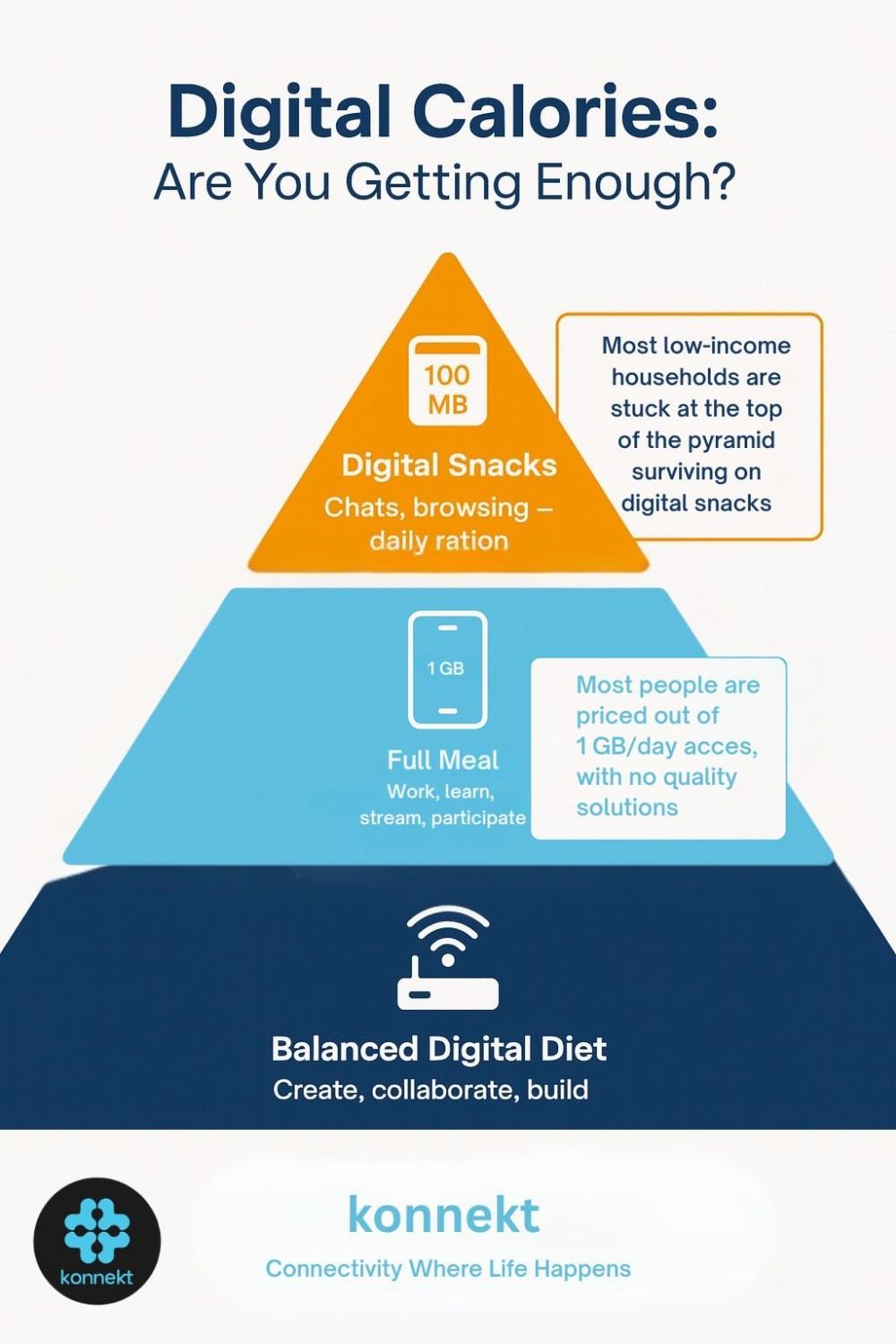
Billions of people are living on digital snacks alone
| Type of access | “Digital calories” | What you can do |
|---|---|---|
| 100 MB/day | Digital snack | Chat, browse, send messages. Survival level |
| 500 MB/day | Light meal | Attend classes, watch short videos, update apps |
| 1 GB/day | Full meal | Work, learn, stream, participate. Basic meaningful inclusion |
| Unlimited broadband | Balanced diet | Create, collaborate, build businesses, innovate |
Right now, billions of people are living on digital snacks, connected enough to scroll, not enough to grow.
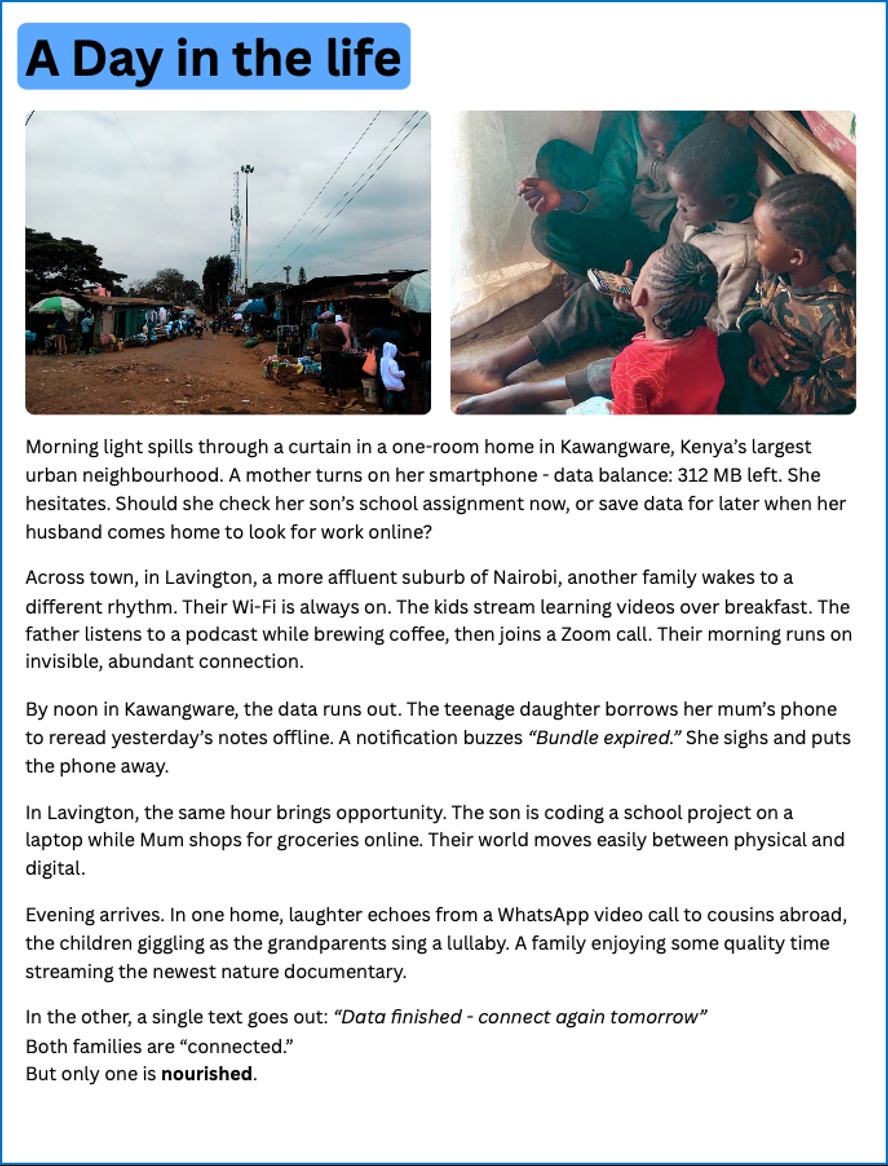
This story is playing out across the world as the digital usage gap widens
Connection Quality: The Hidden Malnutrition
| Type of connection | Approx. speed | What it enables | Reality check |
|---|---|---|---|
| Basic mobile | 1–3 Mbps | Messaging, light browsing | Common in rural and peri-urban areas; enough for chat, not for work |
| Typical 4G user | 5–10 Mbps | Video calls, SD streaming | Average for many Kenyan users. Meets the minimum threshold but unstable |
| Dominant mass-market ISPs | Below 10 Mbps | Browsing, low-res video | Most low-income estates are served by small ISPs averaging 5–8 Mbps: the digital equivalent of cheap street food |
| Fixed home broadband, Kenya | 25–40 Mbps | HD streaming, remote work, multi-user households | Average among major ISPs, adequate for middle-income areas |
| Global average fixed broadband | 80–100 Mbps | Seamless HD, cloud apps, 4K video | Roughly double Kenya’s average; affordable in OECD markets |
| High-end fibre, Kenya | 100+ Mbps | 4K video, uploads, cloud computing | Accessible only to a small urban elite |
The majority of existing solutions for the lower income mass market do not offer access to meaningful connectivity
In Kenya, the average mobile speed is around 10–15 Mbps, while fixed home broadband averages 25–40 Mbps, which are decent, but unevenly distributed. Most ISPs available in mass market low-income neighbourhoods advertise "unlimited" plans that barely reach 8 Mbps, these connections are cheap to buy but starve you of productivity.
It's the junk food of the digital world: quick, available, and affordable, but low in quality, leaving users tired, unproductive, and perpetually hungry for more.
Digital Malnutrition Is Real
If 1 GB/day is the baseline for sustenance, millions across emerging markets are living on less than 200 MB/day which is the digital equivalent of skipping meals. In some cases, people are skipping actual meals in order to purchase data.
They can't join online classes, stream tutorials, or apply for jobs without worrying about bundle expiry. Connectivity has become the new poverty line.
We must ask ourselves:
· What do we actually need to sustain our lives in a digital world?
· Why should access to knowledge and opportunity be rationed like food stamps?
· What would it look like if everyone had enough to grow?
From Survival to Growth
Meaningful connectivity isn't about luxury data plans it's about digital dignity. It's the point where access becomes agency; where connection leads to creation, not just consumption.
If we measured inclusion by digital calories instead of user counts, we'd stop celebrating connection rates and start asking:
"Are people getting enough to live fully online?"
A Call for Digital Nutrition
Governments, ISPs, and innovators can help build a healthier digital diet:
- Invest in infrastructure for low-income urban and peri-urban areas, not just affluent ones.
- Reprice access fairly: make small, daily access affordable per unit, not punitive.
- Zero-rate learning and civic content so that education isn't metered.
- Measure inclusion meaningfully: track data, speed, and device access not just coverage.
Digital inequality isn't about who's online it's about who's getting enough to live, learn, and grow online.
The Future of Digital Wellbeing
The next billion users won't come online with postpaid plans or fibre connections. They'll come from the kidogo economy from daily earners with daily needs.
Our task is to ensure they don't enter a world of digital malnutrition. True inclusion isn't just about being connected it's about having enough digital calories to thrive.