Kenya
Why Kenya's Digital Future Needs New Models Not Just Enforcement
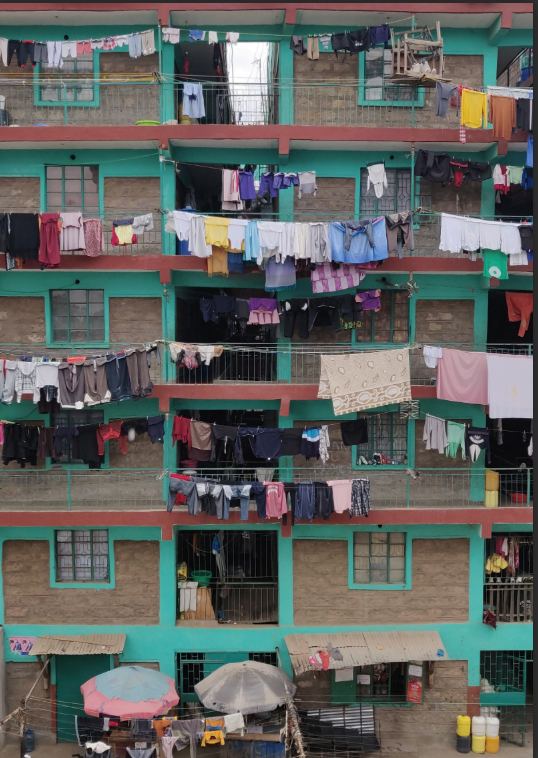
Connectivity has become today's daily bread. It underpins education, jobs, healthcare, and business. Yet in many of Kenya's urban neighbourhoods, millions of households are still excluded from reliable, affordable internet. And the reason is not just infrastructure gaps, it's that the legacy ISP business model simply doesn't fit the environment.
Last week I compared unlicensed ISPs to counterfeit FMCG products: cheaper in the short term, but risky and harmful in the long run. That comparison still holds. Just as counterfeit flour fills a gap left by unaffordable brands, unlicensed ISPs fill a gap left by rigid, expensive connectivity models.
Why Legacy Models Fail
The traditional ISP playbook was built for affluent suburbs:
- High monthly costs of KES 2,500–6,000 ($20-$46), far above what most families in the lower income mass-market can budget. 80% of households in Kenya earn KES 50,000 ($390) or less.
- Rigid contracts that assume stable monthly incomes.
- Infrastructure priorities targeting gated estates, affluent neighbourhoods and business districts, not crowded apartments or informal settlements.
- Business models with ARPU floors, high costs to serve and layered processes make affordable pricing difficult to achieve.
The burden shows clearly when measured as a share of income. In many OECD countries, home broadband costs 0.7%–2% of monthly income. In the UK, for instance, an "average" home broadband deal is about 1.16% of income. In Kenya, by contrast, low-income urban households may spend 7-10% or more of monthly income on home Wi-Fi, several times the global benchmark. That affordability gap pushes families toward rationed mobile data usage, shared access across connections, or unlicensed ISPs, not because they prefer them, but because the alternatives don't fit their financial reality
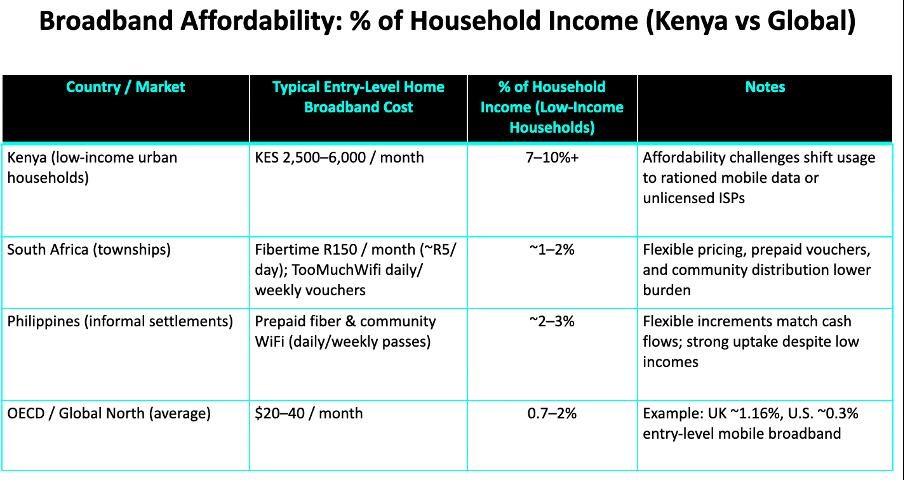
Kenyan's need to pay significantly more than consumers in the Global North or South Africa do for broadband
Technology and Fit: Fibre vs Wireless
Technology choice adds another layer. Fixed wireless, often used because it is cheaper to deploy, struggles in dense urban environments due to interference and line-of-sight challenges. Reliability issues drive churn.
Fibre, while costlier upfront, is far more reliable and efficient in high-density neighbourhoods where thousands of homes can be passed with a single rollout. When paired with prepaid, flexible models, fibre isn't "too expensive" it's the only sustainable long-term option.
Lessons from South Africa and the Philippines
South Africa offers clear examples:
- fibertime™ deploys township fibre with daily vouchers (~R5/day), free installations, and no contracts.
- TooMuchWifi uses "Air Fibre" in underserved communities, selling affordable home connectivity packages and reinvesting into local jobs and suppliers.
In the Philippines, prepaid fibre and community Wi-Fi resellers, such as Surf2Sawa thrive in informal settlements, where households buy connectivity in small, flexible increments much like airtime, or the sachet economy of FMCG. These markets show how technology and business model choices, when adapted to real conditions, can unlock mass adoption.
Innovation Over Enforcement
Unlicensed ISPs are not the disease they are the symptom as has been pointed out by Sidney Essendi. Kenya needs models that are:
- Flexible and prepaid, matching daily or weekly income flows.
- Community-centric, distributed through shops, schools, or local agents.
- Bundled with value, like content or literacy tools.
- Fibre-driven where density allows, to ensure reliability.
- Commercially viable for the long term, so providers can scale sustainably.
Kenya's digital future won't be built on legacy ISP models designed for the privileged few. It will depend on inclusive, reliable, and commercially sustainable models that bridge the affordability gap while maintaining quality. South Africa and the Philippines prove that flexible payments and the right technology can unlock demand at scale.
The real question is no longer how do we stop illegal ISPs? It's this: who will step up to redesign the models that make safe, reliable, and financially sustainable connectivity accessible to every household?